Sea Academy Fondation Sulubaaï
Sulubaaï, Philippines
The BioRestore® process is aimed at local authorities, industrial stakeholders and coastal planners engaged in the sustainable development of coastal areas: it is a tool to revitalize degraded marine environments or to mitigate the inevitable impacts of coastal infrastructure projects (ports, marinas) or offshore energy exploitation.
In an intact coastal ecosystem, the survival rate of natural populations prior to the juvenile stage is estimated at less than 10%. However, as a result of human pressure, in particular the artificialization of the coastline, this rate drops to near zero. With BioRestore®, we achieve a survival rate of around 70%, significantly boosting inshore fish populations.
Rights reserved: Antony Fortin - Ecocean
Black-capped Babbler (C.niger)
Rights reserved: Mathis Bizzari - Ecocean
Lobster (H.gamarus)
Rights reserved: Antony Fortin - Ecocean
Sea bass (D.labrax)
Rights reserved: Mathis Bizzari - Ecocean
Corb (S.umbra)
Rights reserved: Antony Fortin - Ecocean
Octopus (O.vulgaris)
Rights reserved: Antony Fortin - Ecocean
Common conger eel (C.conger)
Rights reserved: Antony Fortin - Ecocean
Common crossbow (B.capriscus)
Rights reserved: Antony Fortin - Ecocean
Mediterranean capelin (T.capelanus)
Rights reserved: Antony Fortin - Ecocean
Common dentex (D.dentex)
Rights reserved: Margaux Blanc - Ecocean
Sea bream (S.aurata)
Rights reserved: Antony Fortin - Ecocean
Brown grouper (E.marginatus)
Rights reserved: Antony Fortin - Ecocean
Capon (S.scrofa)
Rights reserved: Antony Fortin - Ecocean
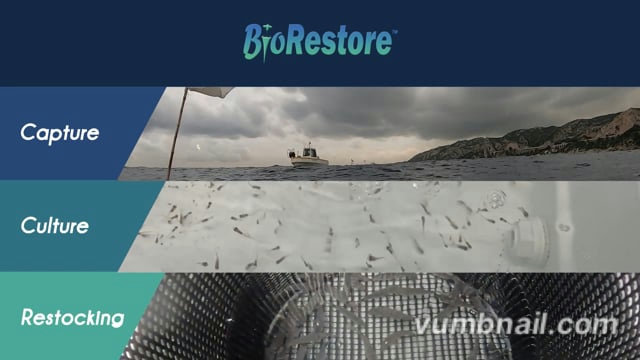
The first phase of the BioRestore® method involves capturing post-larvae of animals seeking nursery grounds using light traps set up at night around the time of the new moon. Called CARE©, this specialized, patented fishing device was designed by Ecocean to enable the non-destructive capture of live post-larvae of fish and marine invertebrates. This step is generally carried out by small-scale fishermen who are partners in the project.
CARE© deployed during a fishing operation
Rights reserved: Rémy Dubas - Ecocean
A fisherman setting a CARE©
Rights reserved: Rémy Dubas - Ecocean
Post-larva of the common sole (Solea solea)
Rights reserved: Antony Fortin - Ecocean
A small cuttlefish (Sepiola atlantica) that has just been caught
Rights reserved: Mathis Bizzari - Ecocean
Once harvested, these post-larvae are acclimated in an aquaculture laboratory, where they will remain for several months. This stage involves rearing the animals according to a non-domestication protocol under optimal conditions and growing them to a size known as the "refuge" stage. This size, generally corresponding to the juvenile stage, is defined as between 7 and 10 cm and marks the point at which the animals have crossed a critical threshold of vulnerability. The scientific community then assesses that they have a high probability of reaching sexual maturity in the wild, thereby extending the impact of their restocking over several generations.
A livestock farm in Marseille housed in a 40-foot shipping container
Rights reserved: Antony Fortin - Ecocean
Young corb (Sciaena umbra) in aquaculture
Rights reserved: Antony Fortin - Ecocean
Brown grouper (Epinephelus marginatus) in aquaculture
Rights reserved: Antony Fortin - Ecocean
Post-larvae of salps (Sarpa salpa) in an aquarium
Rights reserved: Antony Fortin - Ecocean
A specific protocol has been established to maximize the animals’ survival and ensure the success of the final stage of the process: restocking.
This operation, which takes 48 hours, aims to minimize stress on the juveniles as they are transferred from the rearing tanks to their natural habitat. To achieve this, specially designed acclimatization bells provide a gradual transition: installed on a small coastal seabed, they protect the juveniles from predators while allowing them to become accustomed to their new environment. After 24 hours under protection, once the juveniles have acclimatized and recovered from transport, the bells are opened so they can gradually return to their natural environment.
Fish traps full of fish being transported to the restocking dome
Rights reserved: Mathis Bizzari - Ecocean
Sars in a trap being transferred under a restocking dome
Rights reserved: Mathis Bizzari - Ecocean
Restocking dome
Rights reserved: Antony Fortin - Ecocean
Restocking dome opening
Rights reserved: Antony Fortin - Ecocean
A school of sargus (Diplodus sargus) and sea bass (Dicentrarchus labrax) that have just been released
Rights reserved: Antony Fortin - Ecocean
Sulubaaï, Philippines
Cassis, La Ciotat, Marseille, France
Would you like to implement our BioRestore® solution? Gilles is here to assist you.
Information
Credits
Transcription