Commercial port
Are you a commercial port manager looking to launch an initiative to restore aquatic biodiversity? We can help you design a customized project tailored to your port's specific challenges and …
The AD Ports Group and the CMA CGM Group have commissioned Ecocean to design and implement a pilot project to restore marine nurseries within the new terminal at the Khalifa Industrial Port in Abu Dhabi.
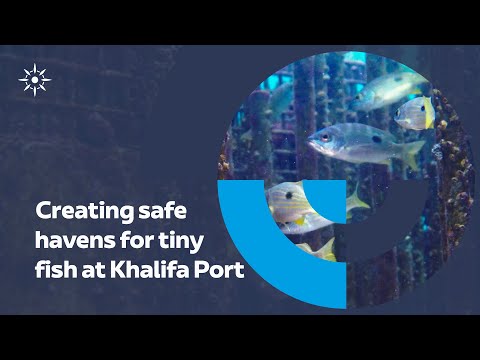
Khalifa Port is a recently developed deep-water port located approximately 60 kilometers east of Abu Dhabi in the United Arab Emirates. Owned by the Abu Dhabi Ports Authority, it serves as a major logistics and industrial hub equipped with modern infrastructure. As part of their commitment to restoring marine ecosystems, the AD Ports Group and the CMA CGM Group sought to develop a pilot project within these new port facilities. To achieve this goal, Ecocean has installed 48 Biohut® units in Khalifa Port and has begun monitoring them to assess the effectiveness of the solution.
« Biodiversity conservation is part of CMA CGM’s “Acting for the Planet” pillar, which lies at the heart of the Group’s sustainability commitments. For years, we have been working with experts to better understand the mechanisms of biodiversity conservation and to support protection and restoration projects that help reduce the environmental footprint of human activities. Given the scale of the challenge, we are convinced that “joining forces” with our partners will accelerate our efforts, and we are delighted with this first example of collaboration with Ecocean in Abu Dhabi, which we hope to replicate in other countries. »
Félix de Carpentier
Step 1 - Site Analysis and Project Design
This initial phase involved assessing the site’s ecological needs, analyzing the port’s specific constraints (environmental, technical, and operational), and developing a tailored solution. It helped determine the type of Biohut to be installed, their layout, and the system’s dimensions in order to optimize its effectiveness.
Rights reserved: OpenStreetMap
Step 2 - Equipment Preparation and Logistics
The Biohut were then prepared, packaged, and shipped to the United Arab Emirates. This logistical step was essential to ensuring the integrity of the equipment and adherence to the installation schedule.
Rights reserved: Ecocean
Step 3 - Installation of the Biohut
The installation was carried out in June 2024 by a team of divers from Ecocean, with support from a local diving company that handled safety and surface logistics. The Biohuts were deployed both along the docks of the CMA CGM terminal and on a main breakwater in the port, in order to diversify the habitats created.
Rights reserved: Ecocean
Step 4 - Ecological Monitoring and Maintenance
Ecological monitoring programs have been established to better understand the colonization dynamics of the Biohuts and the development of biological communities. In particular, these programs allow us to analyze the settlement of juvenile fish and benthic macrofauna within the habitats, as well as to ensure the system’s proper functioning over time.
Rights reserved: Ecocean
Initial lessons
A few months after installation, the Biohuts show rapid and diverse colonization. The presence of very young fish confirms the functional role of these structures as marine nurseries, while the diversity of the invertebrates observed provides a solid foundation for the development of these artificial ecosystems.
Want to talk to our project team? We are here to discuss your needs.
Are you a commercial port manager looking to launch an initiative to restore aquatic biodiversity? We can help you design a customized project tailored to your port's specific challenges and …
Information
Credits
Transcription